Showing posts with label Titus. Show all posts

Tuesday, 30 October 2018

The Pastoral Epistles (Part 2 of 2): Authorship

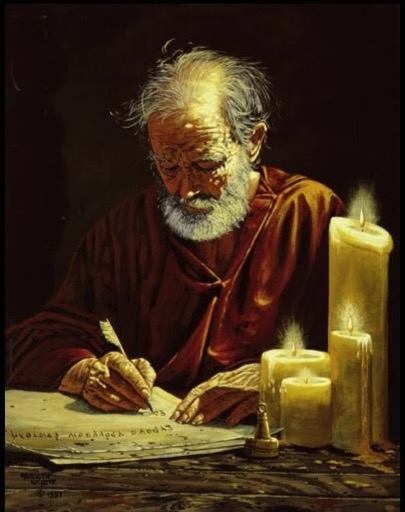
Each of the three letters claims to be from “Paul an apostle of Christ Jesus,” followed by personal comments by him (1 Tim. 1:3; 3:14; 2 Tim. 1:15-18; 4:9-13; Tit. 1:5; 3:12). In Titus the appellation doulos theou (“a slave of God”) is added (as in Rom. 1:1; Gal. 1:10; Phil. 1:1).1 By the time of Irenaeus (ca. 125-200) the Pastorals were unquestionably regarded as genuinely Pauline (Against Heresies 1.1; 1.16.3; 2.14.7; 3.14.1). These letters were utilized by Polycarp, Justin, Heracleon, and others. Clement of Rome betrays familiarity with these writings; also Ignatius, Tertullian, Clement of Alexandria, and the Muratorian Fragment. In fact, “the external attestation for the [Pastoral] Epistles … is as strong as that for most of the other Epistles of Paul, with the exception of I Corinthians and Romans” (D. Guthrie, NT Introduction 585-86). No early Christian writer ever doubted the Pauline authorship of the Pastorals.  
Nonetheless, the Pastorals are the most disputed of all the writings in the NT bearing Paul’s name and are widely regarded among current NT scholars as forgeries composed in the apostle’s name near the end of the 1st century or early in the 2nd century.2 As far back as 1807, F. D. E. Schleiermacher was disputing the Pauline authorship of these letters (Über den sogenannten ersten Brief des Paulus an Timotheus), followed by F. C. Baur in 1835 (Die sogenannten Pastoralbrief des Apostels Paulus). However, not everyone assented to the Schleiermacher-Baur tradition (e.g. J. B. Lightfoot, Biblical Essays 399-418; T. Zahn, Introduction 2:1-133). H. Richards comments: “The reader might like to make his own mind up on this question, since a good case can be made for both sides. Whatever conclusion he comes to, he is assured of being in good company” (St Paul and His Epistles 143).3

The Main Issues

1. The language and writing style of these epistles are quite different when compared to the other letters in the Pauline corpus.

2. The historical situation behind the Pastorals does not fit the framework of Acts.

3. The established positions of episkopoi (“overseers”) and diakonoi (“deacons”) reflect a later, more sophisticated form of church organization.

4. The theology of the Pastorals lacks emphasis on typical Pauline doctrines.

5. Marcion’s canon (mid-2nd century) did not contain the Pastorals, and they are missing from the mid-3rd-century Chester Beatty Papyri (P46).

Responses to these objections

1. The role of amanuenses in Paul’s writings, as well as differences in time, circumstances, addressees, and subject matter, would readily account for any apparent differences in language and style. With reference to the criteria of vocabulary, style and theological motifs, E. E. Ellis observes: “the pseudepigraphal viewpoint was undermined by three new insights of twentieth-century criticism: the role of the secretary; the function of cosenders; and the presence of a considerable number of preformed, non-Pauline pieces in almost all of Paul’s letters” (“Pastoral Letters” 659, cf. 661; also “Pastorals and Paul” 45).4 If heavy use was made in the Pastorals of traditional material, the appearance of so-called “non-Pauline vocabulary” does not make a legitimate case against Pauline authorship (see J. B. Polhill, Paul and His Letters 399-400).
M. Prior argues that at least some of the differences between the Pastorals and the other letters of Paul may be due to the fact that the Pastorals were written as personal letters by Paul alone, whereas the rest were written with secretarial assistance (Letter-Writer 50). Other factors would include Paul’s advancing age and the potential effect of the Latin environment of Rome (E. F. Harrison, Introduction to the NT 364-65). Since these were the final letters in the Pauline corpus to have been written, differences in writing style would be expected. Scholars have observed stylistic differences between the first and seventh books of Julius Caesar’s Gallic War, likely the result of several years between compositions (see J. C. Sang, Selections from Julius Caesar’s Gallic War 2). Further, approximately 80% of the Pastorals’ hapax legomena are found in the LXX, the text in which the apostle Paul was steeped.
If an amanuensis had been used to draft these letters, it is interesting that several words in the Pastorals which have been identified as “non-Pauline” are found in Luke’s writings, and since Luke was with Paul at least when 2 Timothy was written (4:11), it has been suggested that Luke may have been his writing partner.5 Remembering that Luke was a physician, it is of further interest to consider that only in the Pastorals is the metaphorical use of certain words that mean to be sick and to be well. The theme of true and false riches is especially prominent in Luke’s writings and in the Pastorals, and a clear parallel is evident between Paul’s statement in 2 Tim. 4:7 and Luke’s record of Paul’s statement in Acts 20:24. “Perhaps the Lukan affinities in the Pastorals have a simpler explanation. Luke was Paul’s longtime companion. It is likely that the two would have had some mutual influence on the language and expression of each other” (J. B. Polhill, Paul and His Letters 400).6

2. The simplest explanation for why the Pastorals do not fit the framework of Acts is that the letters were written after the historical account in Acts was concluded.7

3. The absence of organization and a lack of perceived sophistication in the early stages of Christianity is an unwarranted assumption (cf. Acts 11:30; 14:23; 15:6; 20:17; Phil. 1:1). Even R. E. Brown acknowledges that an argument “that draws on comparative theology is very weak, since ‘advanced’ theological insights did not all come at the same time in every place” (An Introduction to the NT 697).

4. It is not realistic to expect Paul to have addressed the exact same themes in all of his letters (irrespective of audience, circumstances, and occasion), particularly in view of the fact that the Pastorals are addressed to his close colleagues who were already intimately familiar with the doctrines he taught.8 Furthermore, the letters to Timothy were sent to Ephesus (1 Tim. 1:3), where Paul had previously spent three years proclaiming the whole counsel of God (Acts 20:27, 31). Even the “preeminent” epistle to the Romans lacks some notable Pauline themes (e.g. the Lord’s Supper, the church, Christ’s second coming).

5. Marcion was a heretic who rejected any writings that did not support his views, including Matthew, Mark, John, and portions of Luke (cf. Tertullian, Adv. Marc. 5.1, 21). The Chester Betty Papyri are fragmentary, and the latter part of P46 (where the Pastorals would have been included) has not survived. Toward the end the copyist responsible for P46 appears to have been progressively writing in a smaller hand, thus the seven missing leaves could have contained the Pastorals (J. B. Polhill, Paul and His Letters 399). Alternatively, in view of the fact that Philemon is also missing from P46, J. D. Quinn proposes two separate collections of Paul’s writings, one for congregational letters and one for letters addressed to individuals, and that P46 only represents the former (“P46–the Pauline Canon?” 379-85).

Conclusion

If the Pastorals were in fact written by someone other than Paul, by using Paul’s name and other personal comments supposedly from or about the apostle,9 the pseudonymous writer was obviously being deceptive – the fact of which is perplexing in view of the warnings given in each letter against deceivers (1 Tim. 4:1-2; 2 Tim. 3:13; Tit. 1:10).10 While accepting the self-claims of authorship of only the seven undisputed letters of Paul and the book of Revelation (by an unknown John) and attributing the rest of the NT documents to pseudonymous authors, B. D. Ehrman casually remarks: “A large number of books in the early church were written by authors who falsely claimed to be apostles in order to deceive their readers into accepting their books and the views they represented” (Jesus Interrupted 136). Unfortunately, this is the all-too-common assumption that undergirds the bulk of scholarly literature today.
The least complicated and least problematic solution is to simply accept what the texts claim for themselves. A number of critical scholars still argue in favor of (or at least lean toward) the Pauline authorship of the Pastorals, including D. A. Carson, D. J. Moo and L. Morris, An Introduction to the NT 359-71; E. E. Ellis, “Pastorals and Paul” 45-47; Paul’s Use of OT 5-9; D. Guthrie, Pastoral Epistles 48-53; J. P. Holding, “A Defense”; G. W. Knight, Pastoral Epistles 21-45; C. Spain, Letters 8-15; B. Witherington III, Paul Quest 110-13; K. Wuest, Pastoral Epistles 13-15, 21-23; see also the commentaries of J. Jeremias, J. N. D. Kelly, R. C. H. Lenski, and C. Spicq. While some do not recognize the authenticity of all the Pastorals, they support the Pauline authorship of 1-2 Timothy (A. Kenny, Stylometric 80-100) or at least 2 Timothy (J. Murphy-O’Connor, Paul: A Critical Life 356-59).
--Kevin L. Moore

Endnotes:
     1 Unless otherwise noted, scripture quotations are the author’s own translation.
     2 J. D. Quinn and W. C. Wacker, First and Second Letters to Timothy 1-23; J. Veitch, Faith for a New Age 165-66.
     3 For a survey of arguments for and against Pauline authorship, see D. Barr, NT Story 167-71; E. E. Ellis, “Pastoral Letters” 659-61; D. Guthrie, NT Introduction 584-622; E. F. Harrison, Introduction to the NT 351-63.
     4 See also I. H. Marshall, “Prospects” 137-55; C. F. D. Moule, “The Problem of the Pastoral Epistles” 430-52; M. Prior, Letter-Writer 24-35, 45-59; B. Witherington, Paul Quest 10 n. 3, 110-13.
     5 See C. F. D. Moule, Essays in NT Interpretation 113-32; “The Problem of the Pastoral Epistles” 430-52; E. F. Harrison, Introduction to the NT 365-66; G. D. Fee, First and Second Timothy, Titus 26; E. E. Ellis, Pauline Theology: Ministry and Society 104-111.
     6 See also G. W. Knight, The Pastoral Epistles 50-52. Others have granted an even greater compositional role to Luke (cf. S. G. Wilson, Luke and the Pastorals; J. D. Quinn, “The Last Volume of Luke” 62-75).
     7 See What Happened After Acts? 
     8 For valid responses to arguments based on the nature of the false teaching addressed, theology, church organization, and social/ethical perspective, see J. B. Polhill, Paul and His Letters 400-404; also D. Guthrie, NT Introduction 589-606.
     9 1 Tim. 1:1; 1:3, 12-20; 2:1, 7, 8, 12; 3:14-15; 4:13; 5:14, 21; 6:13; 2 Tim. 1:1; 1:3-6, 8, 11, 12, 15-18; 2:1-2, 7, 9, 10; 3:10-11; 4:1, 6-21; Tit. 1:1; 1:3, 5; 3:12-15.
     10 See D. A. Caron and D. J. Moo, An Introduction to the NT 337-50; D. Guthrie, NT Introduction 671-84; “Development of Canonical Pseudepigraphy” 43-59; B. M. Metzger, “Literary Forgeries” 3-24.


Image credit: https://moldovacrestina.md/pavel-autor-filipeni/ 

Tuesday, 23 October 2018

The Pastoral Epistles (Part 1 of 2): Introduction

The term “Pastoral” to describe 1 Timothy was coined by Thomas Aquinas in 1274 and was used by D. N. Berdot in 1703 and popularized by Paul Anton in 1726 as a collective designation for 1 Timothy, 2 Timothy, and Titus. However, the title “is not technically quite correct in that the Epistles … certainly do not contain a manual of pastoral theology” (D. Guthrie, Pastoral Epistles 11). Nevertheless, because of its familiarity and convenience, “the Pastorals” as a succinct reference to the three letters addressed to two of Paul’s most faithful companions continues to be widely used. Since qualifications of pastors (i.e., shepherds, overseers, elders) are given in 1 Timothy and Titus, the moniker is not entirely illegitimate. While the Pastorals are treated together here for the sake of convenience, they should still be regarded as individual documents.

Distinctive Features

Each of the three letters is written in the name of Paul alone, with no mention of a co-sender. While Paul’s name appearing unaccompanied does not rule out the possibility of secretarial assistance (cf. Rom. 1:1; 16:22), it is interesting that the most disputed Pauline letters (Ephesians and the Pastorals) designate Paul alone in the opening address, with no indication elsewhere in the letters of secretarial involvement. This suggests, contrary to popular scholarly opinion, that these “disputed” letters actually reflect the purest Pauline vocabulary and style, while the rest betray a compositional blend of Paul and his collaborators (see next article).
The stereotypical Pauline greeting (“Grace to you and peace from God our Father and Lord Jesus Christ”) is considerably modified in the Pastorals.1 The term eleos (“mercy”) is added in 1 and 2 Timothy. The usual order of Iēsou Christou (“Jesus Christ”) is reversed in the Pastorals, kuriou (“Lord”) is positioned at the end of the sequence instead of the beginning, hēmōn (“our”) follows Christou Iēsou (“Christ Jesus”) rather than theou patros (“God [the] Father”), and kuriou (“Lord”) is replaced with sōtēros (“Savior”) in Titus.
Besides Philemon, these are the only extant Pauline letters addressed to individuals. However, it is apparent that behind the author’s thought of Timothy and Titus is that of the congregations with which they worked. Each of the letters ends with a grace-wish to “you” (plural) (1 Tim. 6:21; 2 Tim. 4:22; Tit. 3:15). Chronologically, these letters are the final documents in the Pauline corpus.

Provenance, Destination, and Date

On one end of the spectrum, the Pastorals have been dated as late as the 120s-130s (see L. M. White, From Jesus to Christianity 428-33). On the other end, B. Reicke places 1 Timothy in the summer or autumn of 56, Titus in 58, and 2 Timothy in 60 (Re-examining Paul’s Letters 51, 68, 85); J. A. T. Robinson consigns 1 Timothy to autumn 55, Titus to late spring 57, and 2 Timothy to autumn 58 (Redating the NT 67-84).
Around spring of 62, near the end of Paul’s two-year detention in Rome (Acts 28:30), the apostle was anticipating probable release (Philem. 22; Phil. 1:19, 25-26; 2:24), and he later speaks of his “first defense” and deliverance (2 Tim. 4:16-17). Having regained his freedom, Paul traveled to places like Macedonia, Ephesus, Crete, Nicopolis, Troas, Miletus, and possibly also to Corinth, Colosse, and/or Spain  (1 Tim. 1:3; 3:14; Tit.1:5; 3:12; 2 Tim. 4:13, 20; cf. Philem. 22; Rom. 15:28).2 
Probably from Macedonia Paul wrote 1 Timothy, sending the letter to Ephesus (1 Tim. 1:3). He  hoped to visit Timothy in Ephesus but understood that he might be delayed (1 Tim. 3:14-15). On his way to Nicopolis Paul wrote his letter to Titus, sending it to the island of Crete (Tit. 1:5; 3:12). The location of Nicopolis is uncertain, since different cities shared this same name in various places, including Asia, Africa, and Europe. It is possible that this particular Nicopolis was in Thrace (near the borders of Macedonia) or in Cilicia, but more likely in the province of Epirus in northwestern Greece (modern-day Smyrtoula).3 
While there is no way of knowing for sure how long this limited period of freedom was for Paul, these two letters were conceivably drafted sometime around 62-64. Assuming Paul was released from his first Roman detention around spring of 62, this time period would have afforded him the opportunity to travel to the places mentioned in the Pastorals and to have been back in Rome when Nero’s persecution broke out in the summer of 64. According to tradition, Paul suffered martyrdom around this time (see below).
At some point Paul ended up back in Rome as a prisoner and wrote 2 Timothy about 64-65. The apostle was in Rome and was imprisoned at the time of writing (2 Tim. 1:8, 16-17). He implies that his upcoming trial was the second one, and this time he was expecting almost certain death (2 Tim. 4:6-8, 16). Luke was presently with him, and Paul requests that Timothy and Mark come to him before the onset of winter (2 Tim. 4:9-21). According to tradition Paul was executed during the reign of Nero, who instigated his persecution of Christians in the summer of 64 and committed suicide in the summer of 68 (Eusebius, Eccl. Hist. 2.25.1-8).
            In the next post we will address the question of authorship.
--Kevin L. Moore

Endnote:
     1 Unless otherwise noted, scripture quotations are the author’s own translation.
     2 See also Eusebius, Eccl. Hist. 2.22.1-7; I Clement 5.1-7; Jerome, De uiris illus. 5.
     3 See BDAG 673; also D. Guthrie, The Pastoral Letters 16-17; E. F. Harrison, Introduction to the NT 349; McClintock and Strong 7:80-81.


Image credit: https://ca.wikipedia.org/wiki/Fitxer:Paul_in_prison_by_Rembrandt.jpg

Wednesday, 22 November 2017

Background of the Letters to Timothy & Titus: What Happened After Acts?

The historical record of Acts concludes with Paul having been incarcerated in Rome for two whole years (Acts 28:30), with no information about the outcome of his trial or of his death. If, at the time of writing, the apostle was still confined to house arrest and his future still uncertain, the abrupt ending is understandable. There was nothing further to report.
Although weighty attention in Luke’s writings is given to Jerusalem, nothing is said of the fall of Jerusalem (summer of 70), presumably because it had not yet occurred. There is no mention of the Neronian persecution (64-68), even though the story of Acts ends in Rome. While Luke tells of the martyrdoms of both Stephen and the apostle James (Acts 7:57-60; 12:2), there is no record of the death of the Lord’s brother James (who was killed in Jerusalem in the summer of 62), even though he is a prominent figure in Acts (1:14; 12:17; 15:13; 21:18).
Despite Luke’s long-time relationship with Paul, he betrays no knowledge of the apostle’s letters or even mentions that Paul wrote letters. While this raises some intriguing questions, the further in history Luke-Acts is chronologized the more inexplicable this becomes. By the mid-60s the Pauline writings were recognized (at least from Asia Minor to Rome) as a well-known collection and regarded as scripture (2 Peter 3:15-16).
Paul’s correspondence to Timothy and Titus, unlike his other extant writings, do not fit the framework of Acts. The simplest explanation is that they were penned after Acts was completed, thus comprising the final documents in the Pauline corpus. Near the end of his two-year detention in Rome, the apostle was anticipating probable release (Philem. 22; Phil. 1:19, 25-26; 2:24). That he did stand trial before Caesar is presupposed by the divine promise of Acts 27:24, and Paul later speaks of his “first defense” and deliverance (2 Tim. 4:16-17). It would appear that he did in fact regain his freedom and traveled to places like Macedonia, Greece, Asia Minor, Crete, and possibly also to Spain (1 Tim. 1:3; 3:14; Tit.1:5; 3:12; 2 Tim. 4:13, 20; cf. Philem. 22; Rom. 15:28). Imprisoned again at Rome, he writes his final apostolic manuscript as he anticipates almost certain death (2 Tim. 1:16-17; 2:9; 4:6-8). According to early and consistent tradition, during Nero’s reign Paul suffered martyrdom, which would have been no earlier than summer of 64 and no later than summer of 68.
On the night of 18 July 64 a fire broke out in Rome, and five days later at least three of the city’s fourteen sections were destroyed. Nero blamed Christians for the disaster and instigated brutal hostilities against them that lasted until his suicide on 9 June 68 (cf. Tacitus, Annals 15.38-44; Suetonius, Life of Nero 16.2). It is unclear whether the persecution began immediately or took about a year to actuate; the excesses of the brutalities appear to have been diminishing by 67 (see Eusebius, Eccl. Hist. 3.1.3; 2.25.1-8; I Clement 5.1-7; the Acts of Paul; the Acts of Peter; and John Chrysostom, Oppugnatores Vitae Monasticae 1.3).
Provenance, Destination, and Dates of the Pastorals
Spring 62 (the close of the Acts narrative and completion of the prison epistles) would be the earliest possibility for Paul’s release from his first incarceration in the imperial city. His second Roman imprisonment and subsequent death would be no later than summer 68, allowing up to six years for further travels, evangelistic endeavors, and writing projects.  
Prior to his initial arrival in Rome, he had expressed his desire to take the gospel as far west as Spain, soliciting the support of the Roman Christians (Rom. 15:23-29). Although unforeseen circumstances altered the original plan, it is entirely possible that he went on to achieve this goal. It would have taken less than a week to sail from Italy to Spain. Clement of Rome, near the end of the first century, affirms that Paul preached the gospel in the extreme west of the Roman Empire, which at the time would have included Spain (I Clement 5.1-7). The second-century Muratorian Fragment (lines 38-39) and Acts of Peter take Paul’s Spanish journey for granted, as do the fourth-century testimonies of Cyril of Jerusalem and John Chrysostom.
Paul had also made tentative plans to return to the provinces of Macedonia and Asia (Phil. 2:24; Philem. 22). While the order of events is uncertain, Titus accompanied him to Crete and was left there to continue this work (Tit. 1:4-5). Paul also traveled to the west coast of Asia Minor, leaving Trophimus in Miletus (2 Tim. 4:20b) and Timothy in Ephesus (1 Tim. 1:3). While in the vicinity he may have followed through with his plans to visit Philemon in Colosse (Philem. 22) before heading to the port city of Troas (2 Tim. 4:13). From Troas it was a day’s journey across the Aegean Sea to Macedonia (cf. Acts 16:11), where Paul surely fulfilled his wish to see the brethren in Philippi (Phil. 1:24-26; 2:24).
From Macedonia (most likely) Paul wrote 1 Timothy, sending the letter to Ephesus (1 Tim. 1:3); he hoped to join Timothy again in Ephesus but understood he might be delayed (1 Tim. 3:14-15; 4:13). On his way to Nicopolis Paul wrote his letter to Titus, sending it to the island of Crete (Tit. 1:5; 3:12). The location of Nicopolis is uncertain, since different cities shared this same name in various places. It is possible that this particular Nicopolis was in Thrace (near the borders of Macedonia) or in Cilicia, but more likely in the province of Epirus in northwestern Greece (see BDAG 673). The apostle wanted Titus to join him in Nicopolis, where he planned to spend the winter (Tit. 3:12); sometime afterwards Titus would head north to Dalmatia (2 Tim. 4:10) in the southern region of the ancient province of Illyricum (cf. Rom. 15:19). Paul may have also made a trip to Corinth while he was in the area (2 Tim. 4:20a).
There is no way of knowing for sure how long this limited period of freedom was for the apostle, but composing the letters of 1 Timothy and Titus would have been no earlier than 62 and not much later than 64. At some point Paul ended up back in Rome as a prisoner and wrote 2 Timothy (2 Tim. 1:8, 16-17; 2:9). He implies that his upcoming trial is the second one, and this time his death seems imminent (2 Tim. 4:6-8, 16). Luke is presently with him as Tychicus is sent to Ephesus (no doubt to deliver the letter), and Paul requests Timothy and Mark to join him before the onset of winter (2 Tim. 4:9-21). Onesiphorus, who had ministered to Paul in Ephesus, arrived in Rome for a visit (2 Tim. 1:16-18), whereas others were not as loyal (2 Tim. 1:15; 4:10). Reportedly the apostle was executed in Rome near the end of Nero’s reign (64-68) and his corpse buried in the Ostian Way (Caius, Disputation Against Proclus; Eusebius, Eccl. Hist. 2.25.5-6; Jerome, De Viris Illus.). The writing of 2 Timothy, therefore, would fit into this timeframe.
Implications for World Evangelism
Around the time the historical narrative of Acts comes to a close, Paul claims that the gospel has been preached in all the world (Col. 1:5-6, 23). While there may be a hyperbolic element here, the extent of the gospel’s proclamation seems to have been much greater than what is specifically documented in the New Testament. One cannot escape the fact that the message of Christ is universal in scope (Mark 16:15), and its incredibly widespread dissemination in just three decades cannot be denied.
One might argue that by the time Colossians was written, the Great Commission had been fulfilled. Yet the letters to Timothy and Titus, verifying the continued evangelistic efforts of Paul and his coworkers, demonstrate that the task was far from finished. The book of Acts is structured according to six general time periods, each of which ends with a summary statement of the progress made (6:7; 9:31; 12:24; 16:5; 19:20; 28:30-31). If these six periods are symbolically relevant, seeing that the number seven represents completeness, Acts ends with the Lord’s work unfinished.
The final period of the missionary enterprise did not end with Paul’s imprisonment or even his death. In fact, it has still not ended. The story continues. You and I are part of it. As long as there are unsaved people on the planet, especially those who have never heard the good news of Jesus Christ, the Lord’s cause must carry on, even until the end of the age (Matt. 28:20).
--Kevin L. Moore

*Prepared for the 2018 FHU Lectureship.

Related PostsTimothy Part 1Part 2Titus

Wednesday, 30 August 2017

An Instructive Comparison of Timothy and Titus

Both Timothy and Titus were trusted companions of the apostle Paul, each of whom he regarded as a true “son” or “child” [téknon] in the faith (1 Tim. 1:2; Titus 1:4). While indicative of a close relationship, this may also suggest Paul’s role in having led them to Christ. Circumcision is a key issue when both Timothy and Titus are first introduced in the biblical record (Acts 16:3; Gal. 2:1-3). They labored as Paul’s coworkers (Rom. 16:21; 2 Cor. 8:23), and he had enough confidence in them to be his personal delegates (1 Cor. 4:17; 2 Cor. 12:18). Both served as capable evangelists in areas where false teachers had to be confronted and the local church needed to be more firmly established and organized (1 Tim. 1:2-3; Tit. 1:4-5). Preserved in our New Testament is inspired correspondence from the apostle Paul addressed to each of these men.

Despite these similarities, however, there are significant differences between Timothy and Titus.1
·      Timothy plays a major role in the historical narrative of Acts (Acts 16:1–20:4ff.), while Titus is not named at all. It has been suggested that perhaps Luke (the author of Acts) and Titus were brothers, which, for modesty’s sake, would explain why neither name appears in the document.
·      Timothy was half-Jew/half-Greek (Acts 16:1); Titus was full-blooded Greek (Gal. 2:3).
·      Paul determined that Timothy ought to be circumcised (Acts 16:3), though adamantly opposed to Titus being circumcised (Gal. 2:3). Since Timothy was half-Jewish, this was culturally expedient, thereby enhancing his effectiveness in advancing the gospel among fellow ethnic Jews (cf. 1 Cor. 7:19; 9:19-23). Titus, on the other hand, was a Gentile, whose concession to this Jewish rite would have compromised the Christian faith and set a dangerous precedent (Gal. 2:3-5).
·      Timothy appears to have been somewhat timid, sickly, and subject to disregard. The Corinthians were instructed, “if Timothy comes, see that he may be with you without fear … let no one despise him” (1 Cor. 16:10-11);2 Timothy himself was admonished, “Let no one despise your youth …” (1 Tim. 4:12); “use a little wine for your stomach's sake and your frequent infirmities” (1 Tim. 5:23); “being mindful of your tears .... For God has not given us a spirit of fear [timidity] ... Therefore do not be ashamed …” (2 Tim. 1:4, 7-8). Titus, on the other hand, was apparently just the opposite. The Corinthians were told, “he remembers the obedience of you all, how with fear and trembling you received him” (2 Cor. 7:15); “being more diligent, he went to you of his own accord” (2 Cor. 8:17; cf. 12:18).
·      Timothy, it seems, needed elaborate commendations from Paul (1 Cor. 4:17; 16:10-11; Phil. 2:19-24; 1 Thess. 3:2), probably to help bolster his confidence and promote acceptance and respect. Titus, however, did not need such hefty commendations (cf. 2 Cor. 7:15; 8:17; 12:18).
·      There is no clear record that Timothy and Titus were ever together in the same place at the same time, although Macedonia while 2 Corinthians was being drafted is a possibility (see below).
·      Timothy is named as co-sender of more Pauline letters than any of the apostle’s other coworkers (2 Cor. 1:1; Phil. 1:1; Col. 1:1; 1 Thess. 1:1; 2 Thess. 1:1; Philem. 1), while Titus is the explicit co-sender of none. The only writings in the Pauline corpus wherein Timothy is not named are the letters to the Galatians, the Ephesians, and Titus, two of which mention Titus by name. The only Pauline document to record the names of both Timothy and Titus is 2 Corinthians. Paul's mention of “all the brothers with me” in Gal. 1:2 could have included one or the other or both.
·      In the New Testament canon, two letters are addressed to Timothy, and only one to Titus.
·      Timothy was commissioned to help build up a local church on the mainland of Asia Minor (1 Tim. 1:2-3; 2 Tim. 4:5), while Titus worked with multiple churches on the island of Crete (Tit. 1:4-5).
·      According to tradition, both Timothy and Titus died at an advanced age, although Timothy reportedly suffered a violent death as a martyr, whereas Titus died of natural causes.

The point of these comparisons is to illustrate the fact that no two people in the Lord’s kingdom are exactly the same, yet all have the potential of great usefulness in the Lord's service. Whether one is timid and vulnerable, like Timothy, or bold and commanding, like Titus, God can and will accomplish incredible things through anyone who steps out in faith as his faithful servant.
--Kevin L. Moore

Endnotes:
     1 The name Títos (Titus) is of Latin derivation and was a common praenomen among the ancient Romans. The name Timótheos (Timothy) is a Greek name with a Jewish connotation, meaning “of value to God.”
     2 Unless otherwise noted, scripture quotations are from the NKJV.

Related Posts: TitusTimothy Part 1, Part 2,  Part 3


Image credit: https://ak8.picdn.net/shutterstock/videos/17429650/thumb/1.jpg