Showing posts with label authorship. Show all posts

Tuesday, 30 October 2018

The Pastoral Epistles (Part 2 of 2): Authorship

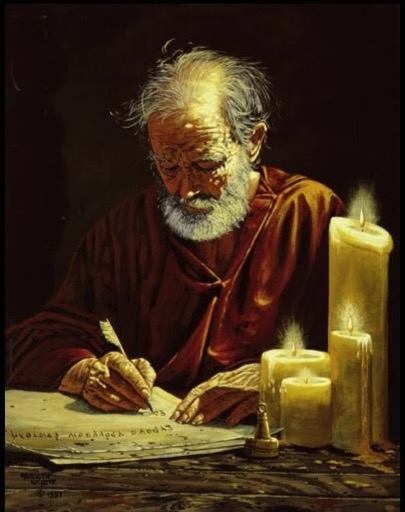
Each of the three letters claims to be from “Paul an apostle of Christ Jesus,” followed by personal comments by him (1 Tim. 1:3; 3:14; 2 Tim. 1:15-18; 4:9-13; Tit. 1:5; 3:12). In Titus the appellation doulos theou (“a slave of God”) is added (as in Rom. 1:1; Gal. 1:10; Phil. 1:1).1 By the time of Irenaeus (ca. 125-200) the Pastorals were unquestionably regarded as genuinely Pauline (Against Heresies 1.1; 1.16.3; 2.14.7; 3.14.1). These letters were utilized by Polycarp, Justin, Heracleon, and others. Clement of Rome betrays familiarity with these writings; also Ignatius, Tertullian, Clement of Alexandria, and the Muratorian Fragment. In fact, “the external attestation for the [Pastoral] Epistles … is as strong as that for most of the other Epistles of Paul, with the exception of I Corinthians and Romans” (D. Guthrie, NT Introduction 585-86). No early Christian writer ever doubted the Pauline authorship of the Pastorals.  
Nonetheless, the Pastorals are the most disputed of all the writings in the NT bearing Paul’s name and are widely regarded among current NT scholars as forgeries composed in the apostle’s name near the end of the 1st century or early in the 2nd century.2 As far back as 1807, F. D. E. Schleiermacher was disputing the Pauline authorship of these letters (Über den sogenannten ersten Brief des Paulus an Timotheus), followed by F. C. Baur in 1835 (Die sogenannten Pastoralbrief des Apostels Paulus). However, not everyone assented to the Schleiermacher-Baur tradition (e.g. J. B. Lightfoot, Biblical Essays 399-418; T. Zahn, Introduction 2:1-133). H. Richards comments: “The reader might like to make his own mind up on this question, since a good case can be made for both sides. Whatever conclusion he comes to, he is assured of being in good company” (St Paul and His Epistles 143).3

The Main Issues

1. The language and writing style of these epistles are quite different when compared to the other letters in the Pauline corpus.

2. The historical situation behind the Pastorals does not fit the framework of Acts.

3. The established positions of episkopoi (“overseers”) and diakonoi (“deacons”) reflect a later, more sophisticated form of church organization.

4. The theology of the Pastorals lacks emphasis on typical Pauline doctrines.

5. Marcion’s canon (mid-2nd century) did not contain the Pastorals, and they are missing from the mid-3rd-century Chester Beatty Papyri (P46).

Responses to these objections

1. The role of amanuenses in Paul’s writings, as well as differences in time, circumstances, addressees, and subject matter, would readily account for any apparent differences in language and style. With reference to the criteria of vocabulary, style and theological motifs, E. E. Ellis observes: “the pseudepigraphal viewpoint was undermined by three new insights of twentieth-century criticism: the role of the secretary; the function of cosenders; and the presence of a considerable number of preformed, non-Pauline pieces in almost all of Paul’s letters” (“Pastoral Letters” 659, cf. 661; also “Pastorals and Paul” 45).4 If heavy use was made in the Pastorals of traditional material, the appearance of so-called “non-Pauline vocabulary” does not make a legitimate case against Pauline authorship (see J. B. Polhill, Paul and His Letters 399-400).
M. Prior argues that at least some of the differences between the Pastorals and the other letters of Paul may be due to the fact that the Pastorals were written as personal letters by Paul alone, whereas the rest were written with secretarial assistance (Letter-Writer 50). Other factors would include Paul’s advancing age and the potential effect of the Latin environment of Rome (E. F. Harrison, Introduction to the NT 364-65). Since these were the final letters in the Pauline corpus to have been written, differences in writing style would be expected. Scholars have observed stylistic differences between the first and seventh books of Julius Caesar’s Gallic War, likely the result of several years between compositions (see J. C. Sang, Selections from Julius Caesar’s Gallic War 2). Further, approximately 80% of the Pastorals’ hapax legomena are found in the LXX, the text in which the apostle Paul was steeped.
If an amanuensis had been used to draft these letters, it is interesting that several words in the Pastorals which have been identified as “non-Pauline” are found in Luke’s writings, and since Luke was with Paul at least when 2 Timothy was written (4:11), it has been suggested that Luke may have been his writing partner.5 Remembering that Luke was a physician, it is of further interest to consider that only in the Pastorals is the metaphorical use of certain words that mean to be sick and to be well. The theme of true and false riches is especially prominent in Luke’s writings and in the Pastorals, and a clear parallel is evident between Paul’s statement in 2 Tim. 4:7 and Luke’s record of Paul’s statement in Acts 20:24. “Perhaps the Lukan affinities in the Pastorals have a simpler explanation. Luke was Paul’s longtime companion. It is likely that the two would have had some mutual influence on the language and expression of each other” (J. B. Polhill, Paul and His Letters 400).6

2. The simplest explanation for why the Pastorals do not fit the framework of Acts is that the letters were written after the historical account in Acts was concluded.7

3. The absence of organization and a lack of perceived sophistication in the early stages of Christianity is an unwarranted assumption (cf. Acts 11:30; 14:23; 15:6; 20:17; Phil. 1:1). Even R. E. Brown acknowledges that an argument “that draws on comparative theology is very weak, since ‘advanced’ theological insights did not all come at the same time in every place” (An Introduction to the NT 697).

4. It is not realistic to expect Paul to have addressed the exact same themes in all of his letters (irrespective of audience, circumstances, and occasion), particularly in view of the fact that the Pastorals are addressed to his close colleagues who were already intimately familiar with the doctrines he taught.8 Furthermore, the letters to Timothy were sent to Ephesus (1 Tim. 1:3), where Paul had previously spent three years proclaiming the whole counsel of God (Acts 20:27, 31). Even the “preeminent” epistle to the Romans lacks some notable Pauline themes (e.g. the Lord’s Supper, the church, Christ’s second coming).

5. Marcion was a heretic who rejected any writings that did not support his views, including Matthew, Mark, John, and portions of Luke (cf. Tertullian, Adv. Marc. 5.1, 21). The Chester Betty Papyri are fragmentary, and the latter part of P46 (where the Pastorals would have been included) has not survived. Toward the end the copyist responsible for P46 appears to have been progressively writing in a smaller hand, thus the seven missing leaves could have contained the Pastorals (J. B. Polhill, Paul and His Letters 399). Alternatively, in view of the fact that Philemon is also missing from P46, J. D. Quinn proposes two separate collections of Paul’s writings, one for congregational letters and one for letters addressed to individuals, and that P46 only represents the former (“P46–the Pauline Canon?” 379-85).

Conclusion

If the Pastorals were in fact written by someone other than Paul, by using Paul’s name and other personal comments supposedly from or about the apostle,9 the pseudonymous writer was obviously being deceptive – the fact of which is perplexing in view of the warnings given in each letter against deceivers (1 Tim. 4:1-2; 2 Tim. 3:13; Tit. 1:10).10 While accepting the self-claims of authorship of only the seven undisputed letters of Paul and the book of Revelation (by an unknown John) and attributing the rest of the NT documents to pseudonymous authors, B. D. Ehrman casually remarks: “A large number of books in the early church were written by authors who falsely claimed to be apostles in order to deceive their readers into accepting their books and the views they represented” (Jesus Interrupted 136). Unfortunately, this is the all-too-common assumption that undergirds the bulk of scholarly literature today.
The least complicated and least problematic solution is to simply accept what the texts claim for themselves. A number of critical scholars still argue in favor of (or at least lean toward) the Pauline authorship of the Pastorals, including D. A. Carson, D. J. Moo and L. Morris, An Introduction to the NT 359-71; E. E. Ellis, “Pastorals and Paul” 45-47; Paul’s Use of OT 5-9; D. Guthrie, Pastoral Epistles 48-53; J. P. Holding, “A Defense”; G. W. Knight, Pastoral Epistles 21-45; C. Spain, Letters 8-15; B. Witherington III, Paul Quest 110-13; K. Wuest, Pastoral Epistles 13-15, 21-23; see also the commentaries of J. Jeremias, J. N. D. Kelly, R. C. H. Lenski, and C. Spicq. While some do not recognize the authenticity of all the Pastorals, they support the Pauline authorship of 1-2 Timothy (A. Kenny, Stylometric 80-100) or at least 2 Timothy (J. Murphy-O’Connor, Paul: A Critical Life 356-59).
--Kevin L. Moore

Endnotes:
     1 Unless otherwise noted, scripture quotations are the author’s own translation.
     2 J. D. Quinn and W. C. Wacker, First and Second Letters to Timothy 1-23; J. Veitch, Faith for a New Age 165-66.
     3 For a survey of arguments for and against Pauline authorship, see D. Barr, NT Story 167-71; E. E. Ellis, “Pastoral Letters” 659-61; D. Guthrie, NT Introduction 584-622; E. F. Harrison, Introduction to the NT 351-63.
     4 See also I. H. Marshall, “Prospects” 137-55; C. F. D. Moule, “The Problem of the Pastoral Epistles” 430-52; M. Prior, Letter-Writer 24-35, 45-59; B. Witherington, Paul Quest 10 n. 3, 110-13.
     5 See C. F. D. Moule, Essays in NT Interpretation 113-32; “The Problem of the Pastoral Epistles” 430-52; E. F. Harrison, Introduction to the NT 365-66; G. D. Fee, First and Second Timothy, Titus 26; E. E. Ellis, Pauline Theology: Ministry and Society 104-111.
     6 See also G. W. Knight, The Pastoral Epistles 50-52. Others have granted an even greater compositional role to Luke (cf. S. G. Wilson, Luke and the Pastorals; J. D. Quinn, “The Last Volume of Luke” 62-75).
     7 See What Happened After Acts? 
     8 For valid responses to arguments based on the nature of the false teaching addressed, theology, church organization, and social/ethical perspective, see J. B. Polhill, Paul and His Letters 400-404; also D. Guthrie, NT Introduction 589-606.
     9 1 Tim. 1:1; 1:3, 12-20; 2:1, 7, 8, 12; 3:14-15; 4:13; 5:14, 21; 6:13; 2 Tim. 1:1; 1:3-6, 8, 11, 12, 15-18; 2:1-2, 7, 9, 10; 3:10-11; 4:1, 6-21; Tit. 1:1; 1:3, 5; 3:12-15.
     10 See D. A. Caron and D. J. Moo, An Introduction to the NT 337-50; D. Guthrie, NT Introduction 671-84; “Development of Canonical Pseudepigraphy” 43-59; B. M. Metzger, “Literary Forgeries” 3-24.


Image credit: https://moldovacrestina.md/pavel-autor-filipeni/ 

Monday, 25 June 2018

The Authorship of Second Peter

     The NT document historically known as 2 Peter claims to be from “Simon Peter, a slave and apostle of Jesus Christ” (1:1), and the author goes on to acknowledge this as the “second letter I am writing to you” (3:1).1 As would be expected, there are multiple allusions in 2 Peter to events recorded in the Gospels (e.g. 1:14, 16-18). Nevertheless, many modern-day scholars deny that the document was actually written by the apostle Peter.2 Here are the main reasons:

1. In the opening address a number of manuscripts read Sumeōn (“Simeon”), the Hebraic form of the Greek Simōn (“Simon”), which indicates the work of a pseudepigraphical writer.

2. A comparison of 1 Peter and 2 Peter shows that the same author did not write both books: (a) The writing styles are different, with 2 Peter being more solemn, repetitive, and cumbersome than 1 Peter, and about 60% of the vocabulary of 2 Peter is not found in 1 Peter. (b) There are several OT quotations in 1 Peter but practically none in 2 Peter. (c) In reference to the Lord’s return, the word apokalupsis (“revelation”) is used in 1 Peter, whereas parousia (“appearance”) is used in 2 Peter.

3. Second Peter seems to have been written after the apostolic generation had died (cf. 3:4) and expectations of the Lord’s imminent return had been disappointed (3:7-15).

4. The writer’s knowledge of a collection of Paul’s letters, particularly viewed in the context of “scripture” (3:15-16), presupposes a much later date.

5. If 2 Peter uses Jude as a source (as is commonly believed by a number of critical scholars) and if Jude was not written until the end of the 1st century, then 2 Peter must have been composed several decades after the apostle Peter’s death.

6. No NT book is as weakly confirmed among the patristic writers or was as slowly accepted into the NT canon as 2 Peter.

Responses to these objections

1. In the opening verse of 2 Peter there is textual variation among extant manuscripts between the Hebraic Sumeōn and the Greek Simōn; the “weight of external support for the two readings is almost equally divided” (B. M. Metzger, Textual Commentary [2nd ed.] 629). The former has been adopted by the NRSV, ESV and NEB, whereas the latter by the ASV, NASB, N/KJV, NIV, and RSV. If Sumeōn is original, it is more likely to have come from Peter himself rather than someone pretending to be the apostle (cf. Acts 15:14). A forger would have surely copied the more common form instead of using such an obscure form.

2. Any variations in style and vocabulary can easily be explained by the unique circumstances under which each document was written, the differences in subject matter, and the contribution of Silvanus to the first letter (1 Pet. 5:12) and his absence from the second.3 Moreover, any attempt to conclusively evaluate a hypothetical “Petrine style” or “Petrine vocabulary” is precluded by the brevity of these writings. While there are a number of OT allusions in 2 Peter (cf. 2:1, 4-8, 15-16; 3:2, 4-6, 9-13) and at least two OT quotations (2:22: 3:8), the theme of suffering in 1 Peter apparently called for more scripture references than the theme of false teachers in 2 Peter. Since the apostle Paul employs both apokalupsis and parousia in reference to the Lord’s return in 1 Corinthians and 2 Thessalonians,4 what would be so unusual about the apostle Peter using both words on different occasions?

3. The allusion to hoi pateres (“the fathers”) in 3:4 does not necessarily refer to first-generation Christian patriarchs (which is nowhere else used as such) but rather to Jewish patriarchs. Further, the teaching of the Lord’s return in 2 Peter is not inherently suggestive of a much later date and is in fact comparable to 1-2 Thessalonians.

4. If Paul kept copies of his letters (which was customary among contemporary authors) and/or these copies were included among the “scrolls” and “parchments” that Timothy was requested to bring to Rome (2 Tim. 4:13), the entire collection could have easily been shared with Peter while the two apostles were in Rome, especially since Mark and Silvanus were colleagues of both of them (2 Tim. 4:11; 1 Pet. 5:12-13). Nonetheless, Peter’s reference to Paul’s “letters” does not in itself imply the entire corpus (though historically possible), and recognition of these writings as “scripture” does not pose a problem for those who accept the self-claims of divine inspiration (e.g. 1 Cor. 2:7-13; 14:37; Eph. 3:1-5). 

5. Questioning 2 Peter because of its literary affinity with Jude is based on the twofold assumption of Jude’s priority and Jude’s late date, neither of which is proven or universally conceded (see The Epistle of Judas).

6. The apparently weak support of 2 Peter in the early church is a fair concern, although M. Green also notes that “no excluded book has nearly such weight of backing as 2 Peter” (The Second Epistle of Peter 13). The weakness of attestation should not be exaggerated, since several 2nd-century writings seem to betray an influence from 2 Peter (cf. R. J. Bauckham, Jude, 2 Peter 162), and Eusebius, while acknowledging its disputed status, affirms its usefulness in study along with tō allōn graphōn (“the other scriptures”) (Eccl. Hist. 3.3.1). 
     While its absence from the Muratorian canon may very well be attributable to the fragmentary state of the text, D. A. Carson and D. J. Moo sensibly observe: “there is a good explanation for the neglect of 2 Peter. So many Petrine forgeries were in existence that the Fathers moved very cautiously in separating out 2 Peter from these other spurious books…. 2 Peter is not mentioned often by the fathers of the church—probably because it is short and so focused on false teaching that it makes little significant theological contribution” (An Introduction to the NT 662, 664).
     There are no close parallels to 2 Peter among the pseudepigraphical writings, and the 2nd century witnessed a whole body of pseudepigraphical literature attributed to Peter that was rejected from the NT canon.5

Conclusion:

     No argument against the Peterine authorship of 2 Peter can decisively stand on its own. Even collectively, when evaluated in light of all the potential variables and available evidence, a convincing case is not made. Unless one is predisposed to doubting the integrity of NT writings, there is no legitimate reason to deny 2 Peter’s self-claim of authorship.
--Kevin L. Moore

Endnotes:
     1 Unless otherwise noted, scripture quotations are the author’s own translation.
     2 R. E. Brown contends that 2 Peter is a “pseudonymous work” that was in all likelihood “chronologically the last NT book to be written …. Indeed, the pseudonymity of II Pet is more certain than that of any other NT work” (An Introduction to the NT 761, cf. 766-68); see also B. D. Ehrman, The NT: A Historical Introduction 421-24; R. E. Van Voorst, Reading the NT Today 504-505. For a good refutation of the arguments, see D. Guthrie, NT Introduction 828-48.
     3 Jerome (340-420) noted: “the two epistles, which circulate as Peter's, are also different in style among themselves and in character, and in word structure; from which we understand that he used different interpreters as necessary” (Ad Hedibiam 120).
     4 On the Pauline authorship of 2 Thessalonians, see The Thessalonian Letters, and Biblical Authorship Part 3 and Part 4.
     5 E.g., Acts of Peter, Apocalypse of Peter, Gospel of Peter, Preaching of Peter, Martyrdom of Peter, Martyrdom of Peter and Paul, the Gnostic Letter of Peter to Philip, and the Gnostic Apocalypse of Peter (see C. R. Holladay, A Critical Introduction to the NT 511).


Image credit: https://www.wacriswell.com/sermons/1960/the-sure-word-of-god/

Tuesday, 19 June 2018

The Authorship of First Peter

     The NT document historically known as 1 Peter claims to be from “Peter an apostle of Jesus Christ” (1:1).1 The author writes authoritatively (1:13-25; 2:1-2, 13, etc.), as an eyewitness of Christ’s sufferings (5:1), with parallels between 1 Peter and Peter’s speeches recorded in Acts: (a) Acts 10:34 and 1 Pet. 1:17; (b) Acts 2:32-36; 10:40, 41 and 1 Peter 1:21; (c) Acts 4:10, 11 and 1 Pet. 2:7, 8. First Peter was unanimously recognized in the early church as an authentic document from the apostle Peter.2 
     Nevertheless, a number of modern scholars reject Simon Peter as the author of this NT epistle.3 Here are the main objections:
1. The excellent quality of Greek and the use of the LXX seem at variance with the alleged authorship of a Galilean Jewish fisherman.
2. The close relationship between 1 Peter and the Pauline writings could suggest literary dependence, which is inconsistent with the apparent hostility between the two apostles (cf. Gal. 2:7-14).
3. The “fiery ordeal” (4:12) suggests a universal imperial persecution, which would not fit into the lifetime of the apostle Peter.
4. The church organization implied in 5:1-4, with an established eldership, points to a much later period in the development of the Christian movement.
5. “Babylon” (5:13) as a metaphoric allusion to Rome arose in Jewish apocalyptic works only after the fall of Jerusalem (cf. 2 Baruch 11.1; 67.7; 4 Ezra 3.1-2, 28).
6. References to the life and ministry of Jesus are almost entirely absent from 1 Peter.

Responses to these objections

1. Notwithstanding the fact that Greek was widely used in 1st-century Palestine and most of the populace was bilingual,4 the secretarial assistance of Silvanus (5:12) sufficiently answers the criticism regarding how the document was composed (see below).
2. Both the presumed hostility between Paul and Peter and any alleged literary dependence have been greatly exaggerated. If the apostles were proclaiming the same message, we would expect to find a number of similarities between their writings. Furthermore, Paul and Peter shared some of the same coworkers (e.g. Silvanus, Mark), whose contribution and influence are often too easily overlooked.
3. Nothing in 1 Peter necessitates a universal imperial persecution but would include any “fiery ordeal” with which the readers were faced.
4. Organized congregational leadership was in place much earlier than many critical scholars wish to concede (cf. Acts 11:30; 14:23; 15:6; Phil. 1:1). Moreover, the various gifts the readers are admonished to utilize (1 Pet. 4:10-11) imply an earlier period.
5. While it is noteworthy that Jewish apocalyptic literature equates Rome with “Babylon” following Jerusalem’s destruction, this evidence does not consider the oral sentiments prior to the written accounts and represents a Jewish perspective but not necessarily that of suffering Christians under Nero (as in 1 Peter) and Domitian (as in Revelation). 
6. The author’s purpose was not to write a Gospel narrative about the life and ministry of Jesus but a letter of encouragement to suffering Christians.

Peter’s employment of an amanuensis

     In 1 Pet. 5:12 the statement is made, “Through Silvanus the faithful brother, as I regard [him], I have written to you briefly …” The question is whether egrapsa (aorist active indicative 1st person singular of graphō) indicates that Silvanus participated in writing the document or was simply its carrier. While some consider as a legitimate use of graphō the sense of to “bear” a letter,5 this is neither its primary meaning nor its most common usage (cf. Rom. 16:22). The verb graphō occurs in the NT 194 times, and in every instance it is used in the sense of “writing,” unless 1 Pet. 5:12 is the only exception.6 In reference to the letters Dionysius had been requested to write, the term egrapsa is used (Eusebius, Eccl Hist. 4:23.12), the exact form of the word found in 1 Pet. 5:12.

Conclusion

     When a NT document makes its own claim of authorship and is supported by ample internal and external evidence, a denial of that claim would require either irrefutable evidence to the contrary or a blind, anti-conservative or anti-biblical predisposition. Suffice it to say, the former is unavailable in the case of 1 Peter.
--Kevin L. Moore

Endnotes:
     1 Unless noted otherwise, scripture quotations are the author’s own translation.
     2 The earliest apparent allusion to this epistle is in 2 Pet. 3:1, where the statement is made: “This now, beloved, I write a second epistle to you.” Not counting possible allusions in other writings (e.g. Clement of Rome, Epistle of Barnabas, Testaments of the Twelve Patriarchs), 1 Peter is quoted by Polycarp in his letter to the Philippians (1, 2, 5), Tertullian (Scorp. 6, 12), and Clement of Alexandria (Strom. 3.11; Inst. 1.6), and is mentioned by name by Irenaeus (Adv. Haer. 4.9.2; 4.16.5; 5.7.2). Eusebius notes Papias’ use of it (Eccl. Hist. 3.39.17) and classified 1 Peter among the “undisputed” NT writings (Eccl. Hist. 3.3.1; 3.4.2).
     3 R. E. Brown, Introduction to the NT 718-19; B. D. Ehrman, The NT: A Historical Introduction 400-401; R. E. Van Voorst, Reading the NT Today 493-94; L. M. White, From Jesus to Christianity 272-74.
     4 A. T. Robertson, Grammar 26-29; cf. D. A. Caron and D. J. Moo, An Introduction to the NT 240, 624, 644-45.
     5 See H. Elliott, First Peter 872-73; P. J. Achtemeier, First Peter 7-9; W. A. Grudem, The First Epistle of Peter 23-24. The following examples are submitted in BAGD (167): IRo 10:1 [Ignatius to the Romans]; IPhld 11:2 [Ignatius to the Philadelphians]; ISm 12:1 [Ignatius to the Smyrnaeans]; Pol 14 [Polycarp to the Philippians]. However, J. B. Lightfoot, A. Roberts, and J. Donaldson translate all of these instances of graphō as “write” rather than “bear” (see Early Christian Writings). 
     6 Some would point to Acts 15:23 as another exception (cf. BDAG 207; ESV, NASB, NIV, N/RSV), but the context does not demand a modification of the usual sense. It is true that the letter was sent with Judas-Barsabas and Silas (vv. 22, 27, 30-32), but someone had to write the letter on behalf of the group, and the most straightforward meaning of v. 23 is that these two men served as amanuenses (N.B. multiple letters would have been needed for the plurality of Gentile congregations). Even if 1 Pet. 5:12 is interpreted as Silvanus having merely been the letter-carrier, this does not rule out the probability that Peter used an amanuensis (which was the common practice of his day) nor does it discount Silvanus as both letter-carrier and amanuensis (cf. Acts 15:22-32).


Image credit: https://thetheology.org/forums/1-peter/

Wednesday, 27 July 2016

The Plural Authorship of Hebrews (Part 2)

NT Examples of Plural Authorship:
     Both letters to the Thessalonians begin by naming three co-senders – Paul, Silvanus, and Timothy (1:1) – and both are written almost entirely in the first person plural (“we”) form of address. Over 96% of the first person terms in 1 Thessalonians are plural, with 92% in 2 Thessalonians, the majority of which are contrasted with “you” (the readers). First person singulars are only occasionally interjected (1 Thess. 2:18; 3:5; 5:27; 2 Thess. 2:5; 3:17), twice with Paul’s name emphatically appended, showing that he was the leading correspondent.
     Since Paul draws attention to the fact that he is writing the postscript with his own hand (2 Thess. 3:17), the implication is that someone other than the apostle did the actual writing of the preceding material. Like Paul, both Silvanus and Timothy were inspired men (Acts 15:32; 2 Tim. 1:6) and acknowledged writers (Acts 15:22-23; 1 Pet. 5:12; 2 Cor. 1:1, 13). Similar features are also found in 2 Corinthians (particularly chaps. 1–9) and Colossians.
The Plural Authorship of Hebrews:
     Since Hebrews displays a literary affinity with Luke-Acts, 1 Peter, and the writings of Paul (see Part 1), it is possible that it is the product of compositional collaboration (as 1-2 Thessalonians appear to be), perhaps involving the cooperative efforts of Luke, Silvanus, Paul, and/or others. Such a possibility renders many of the objections to any one of these potential writers practically insubstantial. 
     When scripture quotations are eliminated,1 Hebrews consists of only eight first person singulars (“I” references) in four verses. The first of these does not occur until nearly eleven chapters have been written (11:32), and the rest are confined to the final chapter (13:19, 22, 23). This is quite uncharacteristic of a single-authored document and supports the hypothesis that Hebrews may have been co-authored, albeit with the infrequent interjection by the dominant member.2
     Hebrews contains 107 plurals in the first person (“we” references), ninety-eight of which are inclusive of the general audience. The remaining nine appear to be references to persons not included among the recipients. 
o   The writer(s) make reference in 2:5 to the coming world, “concerning which we are speaking.”3 This appears to be an allusion to either multiple authors or a lone author and his immediate companions. Since Hebrews is written like a homily or a series of sermons, multiple “speakers” are implied in this passage.
o   In 5:11 the statement is made: “Concerning him we have much … to say.”  Here a clear distinction is seen between “we” and the reading audience (vv. 11b-12). 
o   “We” in contrast to “you” is also evident at 6:9 and 11: “but we have been convinced concerning you, beloved … though we are speaking in this manner …. but we desire each one of you …”
o   The request is made in 13:18, “Pray for us,” followed by three more “we” references and contrasted with “you” in vv. 18b-19. 
A Reasonable Proposal:
     While the documentary evidence (see Part 1 ) seems to point to different individuals (e.g. Paul, Luke, Silvanus), rather than using it to advocate one and discount another, would it be so unreasonable to conclude that they all may have had a hand in the composition? Paul, Luke, and Silvanus were each associated with Timothy (13:23) and had connections with Rome (13:24). Collectively they also had ties with Jerusalem, were familiar with the rituals of Judaism, were steeped in the LXX, and shared an amicable history of ministerial camaraderie and literary collaboration. And all of these men were inspired writers of the NT, including Silvanus (cf. Acts 15:22-23, 32; 1 Thess. 1:1-2; 2 Thess. 1:1-3; 3:17; 1 Pet. 5:12).
     If external evidence supports Pauline authorship and internal evidence raises doubts, it does not have to be an “either-or” situation when the variable of joint-authorship is allowed a hearing. A modern-day demonstration of this proposal is inadvertently provided by D. A. Carson, D. J. Moo, and L. Morris’s collective work, An Introduction to the NT. This co-authored textbook is not neatly divided into designated sections ascribed to the respective writers. Rather, as the authors themselves explain: “Each of us has written about a third of this volume and offered written critiques of the work of the other two. One of us has tried to reduce stylistic and other differences to a minimum. In two or three instances, references in the text betray the individual author. Elsewhere, readers are warmly invited to identify the redactor and the individual sources” (10).
     An apparent weakness of the joint-authorship hypothesis is the statement in Heb. 13:22, “through a few [words] I have written to you.” However, this is similar to the endings in Paul’s letters where he seems to have taken the pen from the amanuensis and written the postscript in his own hand (e.g. Gal. 6:11; Col. 4:18; 2 Thess. 3:17; Philm. 19). Accordingly, Heb. 13:22 would apply merely to the postscript and not to the entire document.
     Perhaps Paul was responsible for the “I” statements (as in 1-2 Thessalonians), which resulted in the entire document being ascribed to him in subsequent generations. Interestingly, every letter attributed to Paul in the NT concludes with a charis (“grace”) benediction.4 This unique feature is also found in Heb. 13:25 but not in any other NT epistle.
Conclusion:
     The original recipients knew the author(s), and the document was quoted, recognized as divinely inspired and authoritative, very early (cf. Clement of Rome, ca. 95-96). Its canonical status is not in question, neither is its value diminished, by ongoing debates about authorship. Nevertheless, this brief study grounds the epistle in the history of the early church and demonstrates that it not only teaches the fundamental importance of unity and cooperation among God’s people (3:13-14; 10:23-25; 12:12-14; 13:1) but appears to be the result of it.
--Kevin L. Moore

Endnotes:
     1 In Hebrews 74 of the 82 first person singulars are found in scripture quotations.
     2 T. Weis comments: “If one is not predisposed to thinking Hebrews is the work of one person, it is very possible to take the plurals in question as representing co-authorship. Viewing the plurals in this way explains the presence of the singulars; the leader of the letter writing team takes the liberty of making personal comments. This is certainly evident in Paul’s work and also in the papyri. Considering that this epistle is a magnum apologetic of Jesus Christ, it is conceivable that more than one person wrote it” (“Literary Plural” 94). See also D. B. Wallace, Greek Grammar Beyond the Basics 396-97.
     3 Scripture quotations are the author’s own translation.
     4 Rom. 16:20; 1 Cor. 16:23; 2 Cor. 13:14; Gal. 6:18; Eph. 6:24; Phil. 4:23; Col. 4:18; 1 Thess. 5:28; 2 Thess. 3:18; 1 Tim. 6:21; 2 Tim. 4:22; Tit. 3:15; Philem. 25. Also in the NT, the noun eppaggelia (“promise”) and its verb form appear mostly in Paul’s letters, Luke-Acts, and Hebrews. 


Image credit: http://etc.usf.edu/clipart/87300/87371/87371_scribe_lg.gif