Showing posts with label Corinth. Show all posts

Wednesday, 29 June 2022

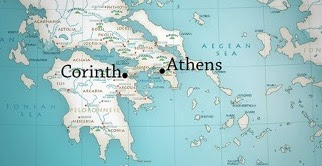
Paul’s Trek from Athens to Corinth

Modern roads and motorized vehicles make it possible to travel from the Greek city of Athens to the ruins of ancient Corinth in about an hour. But in Paul’s day it was not as convenient. Back then there were two options. One could walk about 12 kilometers (7.4 miles) from Athens to the seaport of Piraeus, board a ship and sail 70 nautical kilometers (38 nautical miles) westward across the Saronic Gulf to Corinth’s southeast seaport of Cenchrea, then walk about 9 kilometers (6.5 miles) to the city. It would have taken about half a day of traveling, not counting the additional time constraints involved in the process.1 The other option was to journey across the narrow isthmus of land, a distance of approximately 83 kilometers (52 miles) that would have taken about two and a half days by foot. 


The biblical record simply reports that Paul left Athens and “came to Corinth” (Acts 18:1). No specifics are given about the route he took or his mode of transport. While he did eventually leave by sea (Acts 18:18), nothing definitive can be concluded about the circumstances of his arrival. 


The Likelihood of Land Travel


Luke tends to be explicit whenever Paul journeyed by sea;2 otherwise land travel is assumed. In fact, it seems that when Paul was afforded the opportunity, he preferred land travel over sea travel (Acts 20:13-14).


It is sometimes argued that the sea route from Athens to Corinth would have been more likely for Paul, since the land route was rather dangerous, particularly the mountainous region of the Sceironian Rocks near Megara. This area was named after Sceiron, the mythological bandit who robbed and killed travelers before he himself was killed by king Theseus. Apparently this section of road was notorious for outlaw activity (cf. Alciphron, Letter 3.34).3


The road conditions were also somewhat precarious. Strabo reports:


After Crommyon, and situated above Attica, are the Sceironian Rocks. They leave no room for a road along the sea, but the road from the Isthmus to Megara and Attica passes above them. However, the road approaches so close to the rocks that in many places it passes along the edge of precipices, because the mountain situated above them is both lofty and impracticable for roads. (Geography 9.3.1)4


It may be of interest to note that the second-century geographer Pausanius describes his travels from Athens to Corinth by foot (Descriptions of Greece 1.36.3-44.10). Nevertheless, Paul later informs the brethren at Corinth of the many challenges he faced in his missionary work, including near-death experiences, “dangers of robbers,” “dangers in the wilderness,” “sleeplessness … hunger and thirst … cold …” (2 Cor. 11:23, 26, 27).5 His trek from Athens to Corinth in (late) autumn of the year 50 was one of the rare trips Paul made alone, and these descriptions would certainly fit the land route.


Arrival in Corinth


It appears that Paul arrived in Corinth with depleted funds, indicated by the fact he immediately started making tents with Aquila and Priscilla for his livelihood (Acts 18:2-3). This enabled him to preach to the Corinthians “free of charge” until financial support from Macedonian churches arrived with Silas and Timothy (Acts 18:5; 2 Cor. 11:7-9). Had Paul spent all his money on sea fare? Had he been robbed along the way? Or would the lack of funds have required him to make the journey to Corinth on foot?


If Paul had traveled by land, he would have entered the city from the north along the Lechaeum road that leads to the city-center’s agora or forum. This would have been most conducive to promptly encountering fellow-tentmakers Aquila and Priscilla, locating the Jewish synagogue, and identifying a location for baptizing initial converts (Acts 18:1-8; 1 Cor. 1:14-16).6


Conclusion


Knowing exactly how Paul ended up in Corinth is not a matter of eternal consequence, and no biblical doctrine is affected either way. But for Pauline studies and Bible history, geography, and chronology geeks like me, it is a matter of keen interest. Although short of provable, it seems that a stronger case can be made for the land route taken by Paul from Athens to Corinth as he continued his second major missionary campaign.


--Kevin L. Moore


Endnotes:

     1 “There were no passenger vessels sailing regular schedules in Paul’s day. Cargo ships took passengers on a space available basis. The procedure is described by Philostratus in his Life of Apollonius of Tyana …. This vignette omits the haggling over the fare with a hard-eyed owner or his representative who was determined to get the maximum the market would bear. Presumably, maximum utilization of equipment was as much a concern then as it is today, but the ship’s departure had to await the coincidence of a favorable wind with favorable omens. Passengers, too, had to wait; they could not afford to go too far away because the vessel might sail at any moment” (Jerome Murphy-O’Connor, “On the Road and on the Sea with St. Paul: Traveling conditions in the first century,” Bible Review 1.2 [Summer 1985]: 38-47).

     2 Acts 13:4, 13; 14:26; 16:11; 17:14-15; 18:18-22; 20:3-6, 13-17, 38; 21:1-3, 6-8; 27:1–28:14. Possible exceptions are Acts 9:30 and 21:8.

     3 Alciphron was a Greek sophist who composed a three-volume collection of fictional letters descriptive of various classes of people. His historical period is debated, with proposed dates ranging from the 5th century BC to the 4th century AD, though many believe he was a contemporary of the 2nd-century AD novelist Lucian. In a letter from Limustes to Thrasocydoemus he writes: “Hard pressed for the bare necessaries of life, I joined a band of Megarian brigands, who lie in wait for travelers near the Sceironian rocks; and since then I have gained a dishonest livelihood without working.

     4 Today tunnels have been carved through this mountain pass for safer travel.

     5 Paul also mentions the “three times” he was shipwrecked and the night and day he spent in the deep (2 Cor. 11:25). While it is possible one of these shipwrecks occurred between Athens and Corinth, there is no explicit record of this alleged voyage, whereas at the time 2 Corinthians was written Luke reports no less than nine sea voyages Paul had taken. As far as sea travel is concerned, of the many trips Paul made, a prospective brief passage across the Saronic Gulf would have been one of the safer ones.

     A stone lintel, inscribed “synagogue of the Hebrews” (albeit fragmentary), was discovered along the Lechaeum road. On the road’s east side before entering the agora are the remains of the ancient Fountain of Peirene, which in Paul’s day had plenty of water for public use.


Related PostsAncient CorinthChronology of Paul's Work in CorinthMy Family's Worship in Corinth


Image credit: http://www.doncronerblog.com/2017/03/greece.html

Wednesday, 22 June 2022

My Family’s Worship in Corinth

My family and I recently visited Greece. On Sunday we were in Loutraki, about 19 kilometers (12 miles) from the ruins of ancient Corinth. We self-toured the museum and the city’s ruins, highlighting the places and artifacts most relevant to the Bible.1 Then we walked a couple hundred meters from the fenced-in site to find the Erastus stone. Located adjacent to the remains of the ancient theater, it is a long block of limestone with a Latin inscription that includes the name Erastus. The inscription documents Erastus having laid the pavement stone at his own expense in return for the honor of the office of aedile.2


The name Erastus occurs in the NT three times (Acts 19:21-22; Rom. 16:23; 2 Tim. 4:20) in association with Paul, Timothy, and the Corinth church. The apostle Paul, writing from Corinth, describes Erastus as ὁ οἰκονόμος τῆς πόλεως (lit. “the steward of the city”).3 It’s hard to ignore the apparent link between the biblical record of our brother Erastus, a city official in Corinth, and the archaeological evidence of Erastus, a city official in Corinth. 


For our worship that afternoon, we sat in a shaded area near the inscription, feeling as if we were in some way including Erastus and connecting with the first-century church in Corinth.  


Singing and the Lord’s Supper 


We sang, “We Shall Assemble on the Mountain,” “Amazing Grace,” and “Man of Sorrows.”


For the Lord’s Supper we read a passage Paul had written to the Christians in Corinth:


“Therefore, my beloved, flee from idolatry. I speak as to sensible ones, judge for yourselves what I say. The cup of blessing that we bless, is it not participation in the blood of Christ? The bread that we break, is it not participation in the body of Christ? Because there is one bread, we who are many are one body, for we all partake of the one bread” (1 Cor. 10:14-17).


After the Lord’s Supper we sang, “Jesus, Name Above All Names.”


The Bible Lesson:


Paul spent about 18 months in Corinth, working with Aquila, Priscilla, Silas, and Timothy, leaving behind an established community of Christians (Acts 18:1-18). A few years later he returned, and during the winter of 56-57 he and Tertius wrote the letter to the Romans wherein it is stated: “Gaius, the host of me and of the whole church, greets you. Erastus, the steward of the city, and our brother Quartus, greet you” (Rom. 16:22-23).


Apparently the church was meeting in Gaius’ house, which was large enough to host a sizeable group.4 It would have been a Roman-style house (domus), similar to what we saw in Pompeii, where the main foyer (atrium) had the capacity to accommodate a maximum of 30-50 people. 


The mid-first-century church at Corinth had many problems, at the heart of which was a lack of love. As Paul concludes the letter of First Corinthians, he gives this admonition: “Let all you do be done in love” (1 Cor. 16:14). Earlier in the letter he devoted a whole chapter to love, so let’s listen to these inspired words as Erastus and the other Christians in Corinth would have first heard them.


Having stressed the importance of love (1 Cor. 13:1-3), Paul then gives a description of love (vv. 3-8a):

Love is patient, not merely with circumstances but especially with people.

Love is kind, the other side of patience; a positive, active response.

Love is not envious or jealous, not displeased with another’s good fortune.

Love is not boastful, not self-asserting.

Love is not arrogant or prideful.

Love does not behave rudely or act unbecomingly.

Love does not seek its own, is not selfish, does not demand its own way.

Love is not easily provoked to anger, a selfish concern for one’s own personal rights or perceived needs.

Love “thinks no evil” (NKJ), or “does not take into account a wrong suffered” (NAS), or “keeps no record of wrongs” (NIV); it does not hold a grudge or preserve a mental list of another's mistakes.

Love does not rejoice in iniquity or unrighteousness, it has no pleasure in the prevailing of sin or the misfortunes of others.

Love rejoices with the truth: the joy of honesty, not indifferent toward moral issues, delights in the truth of God’s word. 

Love bears all things, willing to put up with petty imperfections.

Love believes all things, trusting, giving the benefit of the doubt.

Love hopes all things, eager anticipation of what lies ahead.

Love endures all things, does not easily give up on each other, the church, or the Lord.

Love never fails, it will endure forever (because God himself is love, 1 John 4:8).


Let’s make sure we consistently love God, each other, our church family, and our neighbors as we seek to draw others closer to the love of God and the God of love.


Singing and Prayer


We sang, “I Love You with the Love of the Lord,” and “Bind Us Together Lord.” Then we prayed.


--Kevin L. Moore


Endnotes:

     1 The museum houses a stone lintel inscribed “synagogue of the Hebrews” (albeit fragmentary) and a stone capital with images of menorahs and palm branches, evidence of a Jewish community and synagogue in ancient Corinth (Acts 18:4-8, 12-17). The synagogue was at one time located next to the house of Titius Justus (Acts 18:7). The ruins of the massive temple of Apollo and other smaller temples, which served among other things as community centers, are relevant to Paul’s words in 1 Cor. 8:10, “For if anyone sees you having knowledge eating in an idol’s temple …” These temples, along with many other pagan shrines, statues, and artifacts, show why Paul deemed it necessary to repeatedly warn the Corinthians about the dangers of idolatry (1 Cor. 5:10-11; 6:9-11; 8:1-13; 10:7, 14, 19-22, 28; 12:2; 2 Cor. 6:16a), along with reminders that as God’s people we are his sacred temple (1 Cor. 3:16-17; 6:19; 2 Cor. 5:1; 6:16). The agora or forum brings to life the admonition in 1 Cor. 10:25, “Eat whatever is sold in the marketplace without asking questions on account of conscience.” All around the agora are abandoned shops where the tentmaking business of Aquila, Priscilla, and Paul may have been located (Acts 18:1-3). Along the Lechaeum road leading to the agora are the remains of the public Fountain of Peirene, which would have been an ideal location for baptizing initial converts (Acts 18:8; 1 Cor. 1:14-16). The Bema, the large stone platform where Paul was brought before the Roman proconsul Gallio (Acts 18:14-16), still stands in the center of the agora.

     2 The stone is about 2.2 meters (7.5 feet) in length. A reconstruction of the worn, abbreviated inscription, probably covered originally with bronze lettering, reads: ERASTVS PRO AEDILIT[ATE] S(UA) P(ECUNIA) STRAVIT. In Rome the office of aedile, which included the maintenance of public buildings and regulating public festivals, was more prestigious during the Republic but lost much of its importance during and after the reign of Augustus. In the Empire-era the authority and responsibilities of this position varied in the different cities and colonies.

     3 Scripture references are my own translation, unless noted otherwise.

     4 Names associated with the first-century Corinth church, along with households and unnamed brethren, include Crispus, Titius Justus, Stephanas, Sosthenes, Gaius, Fortunatus, Achaicus, Tertius, Erastus, and Quartus (Acts 18:7, 8, 17; Rom. 16:22-23; 1 Cor. 1:1, 14, 16; 16:17; 2 Tim. 4:20); perhaps Epaenetus (textual variant in Rom. 16:5), and Phoebe of Corinth’s SE seaport of Cenchrea (Rom. 16:1). Also involved in this work at various times were Paul, Aquila, Priscilla, Silas [Silvanus], Timothy, Apollos, and Titus (Acts 18:1-18; 18:27–19:1; 1 Cor. 4:17; 16:10-12; 2 Cor. 1:19; 7:6-7; 8:6, 16-24; 12:17-18).


Erastus Stone

Related Posts: Kaitlyn's PostMy Family's Worship in RomeAncient Corinth


Image credit: https://beliefspeak2.net/2016/10/10/new-testament-inscriptions-erastus-of-corinth-acts-1922-romans-1613-2-timothy-420-holylandphotos-blog/

Also self-family-photo with the ruins of Apollo's temple in the background.

Wednesday, 3 October 2018

Chronology of Paul’s Work in Corinth

Background
     Lucius Junius Gallio Novatianus (a.k.a. Gallio) began his one-year office as proconsul of Achaia in June 51. An inscription discovered at Delphi and published in 1905 (with additional fragments found and then published in 1970) dates between April and July 52. From this we can deduce that Gallio was the proconsul of Achaia in the previous year (cf. Acts 18:2, 12).
     Emperor Claudius had dispelled Jews (including Aquila and Priscilla) from Rome in 49 (his 9th year as emperor). The dating of Claudius’ edict comes primarily from the 5th-century historian Paulus Orosius (Hist. Adv. Pag. 7.6.15-16), and even though there is a degree of uncertainty as to the exactness of this date (cf. J. Murphy-O’Connor, Paul: A Critical Life 9-10), it is consistent with other chronological data (Josephus, Dio Cassius, Suetonius) and is based on historical information available to Orosius that is no longer extant. 
     Paul and Barnabas met with the apostles and elders in Jerusalem to discuss the circumcision controversy (Acts 15:1 ff.) early in the year 50, fourteen years after Paul’s visit in 36 (Gal. 2:1).1 Afterwards, over the next few months, Paul’s missionary team started churches in the region of Macedonia, viz. in the cities of Philippi, Thessalonica, and Berea, then on to Athens (Acts 16–17).
Paul’s Work in Corinth
     The apostle would have arrived in Corinth from Athens around late autumn of the year 50. He labored with Aquila, Priscilla, Silas and Timothy until spring of 52, leaving behind an established Christian community (Acts 18:1-18). After his departure via the seaport of Cenchrea, Paul seems to have had no further communications with the Corinthian brethren until sometime during his three years’ ministry in Ephesus (Acts 20:31; 1 Cor. 16:8).
     Paul wrote a letter to the Corinthians in which he warned them not to associate with immoral persons (1 Cor. 5:9), and Timothy was sent to Corinth to remind them of the apostle’s teachings (1 Cor. 4:17). Paul received reports from Chloe’s people of certain disorders among the Corinthians (1 Cor. 1:11), and he welcomed a delegation from Corinth, namely Stephanas, Fortunatus and Achaicus (1 Cor. 16:17), who delivered a letter from the brethren seeking his advice on various questions (1 Cor. 7:1). In response Paul wrote the epistle of 1 Corinthians from Ephesus in the spring of 56 (cf. 1 Cor. 4:19; 16:8).
     An unsuccessful attempt had been made to get Apollos to revisit Corinth (1 Cor. 16:12), while Paul was planning to return to Corinth himself (1 Cor. 4:18-19; 11:34; cf. 2 Cor. 11:10; 12:21) to impart “a second blessing [cháris]” (2 Cor. 1:15). This could refer to his next return since the inaugural campaign (cf. 2 Cor. 12:14; 13:2; discussed further below). Another possibility is the fact that two upcoming visits had been planned – one on the way to Macedonia (2 Cor. 1:16a) and the other from Macedonia (v. 16b) – thus the first and second “blessing,” although the first of these did not eventuate.
     His initial intention was to stop in Corinth on his way to Macedonia, then revisit the Corinthians on his way from Macedonia to Judea and be assisted by them (2 Cor. 1:16; cf. 1 Cor. 16:6; Acts 19:21). However, for reasons presumably beyond his control, he had to change his travel plans and go to Macedonia first (1 Cor. 16:2-7; cf. 2 Cor. 1:12-24) via Troas (2 Cor. 2:12-13), although he did not want to visit the Corinthians while he was agitated with them (2 Cor. 1:23; 2:1-4; cf. 12:20-21; 13:10).
     Titus had been to Corinth and met Paul in Macedonia, reporting on the situation among the Corinthian disciples (2 Cor. 7:5-7, 13-15). From Macedonia (2 Cor. 7:5; 9:2-4) Paul and Timothy wrote 2 Corinthians in the summer and/or autumn of 56. Some interpret the evidence differently and propose three visits and four letters to Corinth (e.g. L. Morris, First Corinthians 22-25; C. Kruse, Second Corinthians 17-25; cf. G. Guthrie, 2 Corinthians 18-32).
     Paul states: “this [is the] third [time] I am ready to come to you” (2 Cor. 12:14), and “this [is the] third [time] I am coming to you” (13:1).2 These statements seem to be alluding to: (a) his inaugural visit to Corinth (Acts 18); (b) the intended visit on the way to Macedonia that did not occur (2 Cor. 1:15-17); and (c) the upcoming visit he is planning to make. This conclusion is corroborated by the next statement in 13:2, “I have warned and I am warning, as being present the second [time] and being absent now … if I come again …” This would indicate that Paul had been to Corinth once before (Acts 18), and though his previous plan to return did not eventuate, this letter is a prelude to his upcoming second visit (cf. 2 Cor. 9:1-5; 10:2, 11; 12:20-21; 13:10). Titus and other brothers were sent back to Corinth probably to deliver the letter and to help get the contribution ready which the Corinthians had proposed a year earlier (2 Cor. 8:6-24; 9:2-5; 12:17-18).
Paul’s Return to Corinth
     Paul did eventually return to Corinth, spending the three winter months of 56-57 in Greece (Acts 20:2-3), during which time he and Tertius wrote the epistle to the Romans. While it is possible that Paul revisited Corinth after his release from the first Roman imprisonment around 62-64 (cf. 2 Tim. 4:20), this cannot be confirmed.
Conclusion:
     Paul was not in the habit of making converts and then leaving them to fend for themselves (see They Returned). His documented work in Corinth demonstrates that he invested significant time and energy in fulfilling the great commission by making disciples and establishing congregations with ongoing contact and follow up.
--Kevin L. Moore

Endnotes:
     1 The question here is whether to understand the three years of Gal. 1:18 and the fourteen years of Gal. 2:1 concurrently or consecutively. Adding the fourteen years to Paul’s initial post-conversion Jerusalem visit does not present any insurmountable chronological difficulties. What creates a greater degree of uncertainty, however, is the ancient practice of counting a portion of the first and last years as a full year in the calculation.
     2 Unless otherwise noted, English translation of scripture is the author’s own.


Image credit: http://studyofcorinthians.blogspot.com/2014/08/corinth.html

Wednesday, 23 November 2016

Stop getting drunk at church and do it at home?


     Paul writes to the problem-plagued Christian community in Corinth: “For in eating, each one goes ahead with his own meal. One goes hungry, another gets drunk. What! Do you not have houses to eat and drink in? Or do you despise the church of God and humiliate those who have nothing? What shall I say to you? Shall I commend you in this? No, I will not” (1 Cor. 11:21-22 ESV).
     Although the English rendering of the verb methúō in this passage is “drunk,” it is set in contrast to “hungry” (v. 21) – not necessarily meaning intoxicated but rather indicative of some having over-indulged in both food and drink (v. 22a), while others were left wanting. Such segregation and partiality among Christians show disdain and contempt for God’s church (v. 22b; cf. Jas. 2:1-9). If this is how they were going to act, they should eat and drink at home before they come to the assembly.
     The infinitive “to drink” in v. 22 does not specify what beverage is consumed any more than “to eat” specifies what is eaten. Earlier Paul had reminded the Corinthians that being a faithful Christian and being a drunkard [méthusos] are mutually exclusive (5:11; 6:10), and elsewhere Paul forbids intoxication [methúskō] (Eph. 5:18). Unless inebriants are necessarily in view, the sense of methúō is simply fullness or excessiveness (cf. John 2:10; Rev. 17:2, 6).
--Kevin L. Moore


Related articles: Scott Shifferd's Reconsider Biblical Drunkenness

Image credit: http://images.techtimes.com/data/images/full/50460/drunk.jpg